

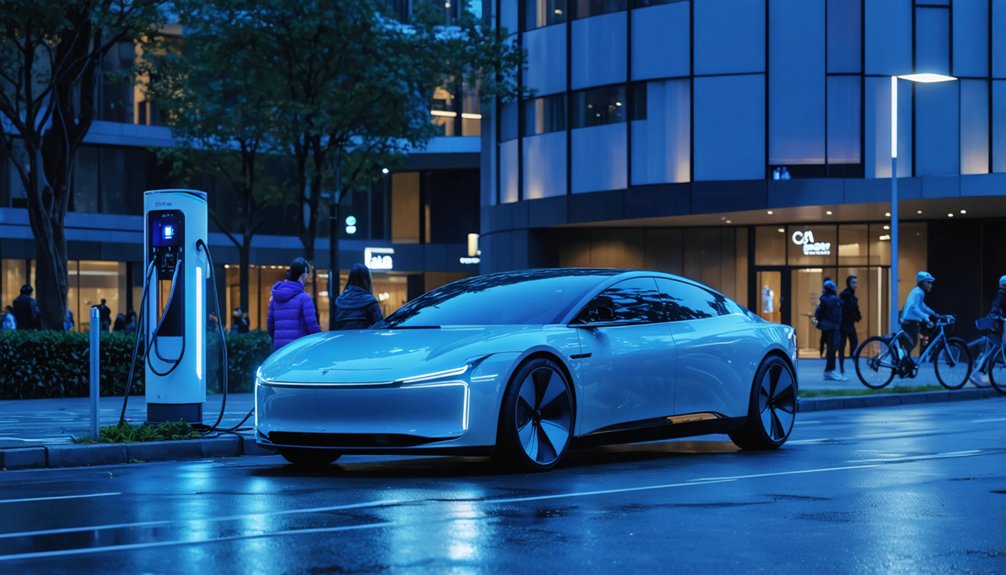

Automakers are focusing on compact electric vehicles due to surging market demand and changing consumer preferences. These vehicles meet urban mobility needs and offer practicality and affordability. Advances in technology enhance their viability by improving battery efficiency and reducing charging times. Regulatory incentives further promote compact EV adoption, aligning with sustainability goals. The environmental benefits, including reduced emissions, make compact EVs an attractive choice. Investigate how these factors drive the compact EV market forward.
Highlights
- Demand for sustainable urban transportation solutions drives automakers to focus on compact electric vehicles suited for city living.
- Increasing affordability and practicality make compact EVs more appealing to consumers as average prices decrease.
- Regulatory incentives, such as federal tax credits and vehicle caps, favor the development of smaller, more affordable EVs.
- Advances in battery technology enhance efficiency, allowing for longer ranges and faster charging, making compact EVs more viable.
- Compact EVs significantly reduce greenhouse gas emissions and enhance urban air quality, aligning with environmental goals and consumer values.
Growing Market Demand for Compact EVs
The growing market demand for compact electric vehicles (EVs) is driven by an intersection of factors including shifting consumer preferences, urbanization, and environmental regulations. Market analysis reveals an anticipated 25% growth in global passenger EV sales by 2025, underscoring significant sales trends. In the U.S., EV market share rose to 7.4% in Q2 2025, with consumers increasingly gravitating towards smaller, cost-effective models. This shift is heightened by the pending expiration of federal tax credits, which is predicted to spike sales in Q3 2025. Additionally, the burgeoning used EV market, with a 32.1% year-over-year increase, showcases a growing appetite for affordable options. As urban areas expand, the demand for compact EVs continues to strengthen, reflecting consumer needs and regulatory imperatives. Moreover, Tesla’s market share remains a dominant force, accounting for 46.2% of the U.S. EV market in the same period, indicating a strong preference for established brands in the compact segment. Furthermore, used EV sales surged by 32.1% year over year, showcasing the growing interest in budget-friendly electric vehicles. Emerging economies are also experiencing rapid adoption, showcasing the global trend towards compact and affordable electric mobility.
Consumer Preferences Driving Compact EV Adoption
As urban environments become increasingly congested, consumer preferences are shifting decisively towards compact electric vehicles (EVs). Compact preferences are driven by several factors, including affordability and practicality. With the average used EV price decreasing substantially, more budget-conscious buyers find compact models appealing. Furthermore, advancements in battery technology improve electric vehicle efficiency and range, making them even more viable for urban consumers. Additionally, EV shoppers consider products from mass market and premium brands alike, broadening the options available for compact EV buyers. Urban trends favor these nimble vehicles, as they facilitate easier parking and maneuverability, vital for city driving. Additionally, consumers are increasingly conscious of sustainability, choosing compact EVs for their lower environmental impact. The availability of diverse models with customizable options further enhances their attractiveness, catering to individual preferences. Collectively, these factors promote a growing sense of belonging among consumers, uniting them in the pursuit of efficient and eco-friendly transportation solutions. Furthermore, the expansion of EV charging infrastructure makes owning a compact EV more convenient than ever, encouraging urban dwellers to choose these vehicles over traditional options.
Technological Innovations Enhancing Compact EV Viability
Amid rising consumer interest in compact electric vehicles (EVs) fueled by urban mobility demands, technological innovations play a substantial role in enhancing their viability. Advances in battery efficiency, particularly with solid-state batteries and new cell designs, are substantially improving range and safety. Furthermore, reduced charging times are becoming a hallmark of these vehicles, allowing for ultra-fast charging, which enhances daily usability. Coupled with the expansion of charging infrastructure, which alleviates range anxiety, compact EVs become increasingly practical for urban dwellers. Additionally, lightweight materials and innovative vehicle designs contribute to energy efficiency, while advanced software features create a seamless user experience. Together, these developments position compact EVs as a desirable option for modern urban lifestyles. With improved batteries that enable ranges of 600 km or more, these vehicles are better equipped to meet the demands of city driving. Notably, electric vehicles like the Rivian R2S demonstrate how compact EVs can combine range and utility for urban dwellers. Moreover, as battery technology continues to improve, 90% of EV manufacturers believe it will significantly impact the design and performance of EVs in the near term.
Competitive Landscape in the Compact EV Segment
With the rising popularity of compact electric vehicles (EVs), the competitive scene within this segment is becoming increasingly lively. Tesla leads the U.S. market with approximately 44.7% share, although this figure is gradually declining. Meanwhile, General Motors exhibits aggressive growth, doubling its EV sales year-over-year, driven in part by the success of the Chevrolet Blazer EV. However, Ford faces challenges as its sales wane in 2025. Market trends indicate a consumer preference for compact crossovers, such as the Hyundai Ioniq 5 and Chevy Equinox EV. Legacy automakers invest heavily in EV strategies, expanding model lines to directly compete with Tesla. As the market matures, fluctuating sales reflect the changing interplay of consumer confidence and economic pressure, emphasizing the increasing stakes within the compact EV scenery.
Regulatory Incentives Promoting Compact EV Sales
Regulatory incentives play a crucial role in strengthening sales of compact electric vehicles (EVs) by making them more financially accessible to consumers.
Federal credits, such as a tax incentive of up to $7,500 for new vehicles and $4,000 for pre-owned models under $25,000, substantially lower purchase prices.
MSRP caps of $55,000 favor smaller, more affordable EVs, and North American assembly requirements guarantee domestic models benefit most.
Additionally, state and local incentives, including partial rebates and exemptions, further enhance affordability.
These regulatory structures drive manufacturers to focus on compact EVs, aligning product services with consumer needs and compliance demands.
Ultimately, these incentives create a supportive ecosystem for compact EV adoption within communities keen to accept sustainable transportation.
Urban Mobility Needs Favoring Compact Vehicles
The growing urban population is intensifying the demand for compact electric vehicles (EVs), which are ideally suited for traversing congested city streets. Urban planning and city infrastructure are increasingly prioritizing smaller, more maneuverable vehicles that can traverse limited parking and tight spaces.
The compact EV’s ability to reduce overall vehicle size on roads alleviates traffic congestion, addressing the needs of budget-conscious urban residents who favor affordability and operational efficiency. Furthermore, these vehicles are compatible with emerging shared mobility solutions, enhancing accessibility and convenience.
As cities adapt to the challenges of urbanization, the focus on compact EVs reflects a collective desire for sustainable and practical transportation options that genuinely harmonize with the needs of modern urban life. Additionally, these vehicles are suited for urban environments where people live and work, reflecting a shift towards sustainable transportation that aligns with the values of city dwellers.
Environmental Benefits of Compact Electric Vehicles
Compact electric vehicles (EVs) offer significant environmental benefits, particularly in reducing greenhouse gas emissions throughout their life cycle. Compared to gasoline cars, compact EVs generate approximately 73% less life-cycle emissions, substantially aided by their efficient energy conversion of 65-69%.
This eco-friendly technology contributes to lower overall energy demand and minimizes resource consumption. Moreover, compact EVs produce zero tailpipe emissions, eliminating pollutants such as nitrogen oxides and particulate matter, enhancing urban air quality and public health.
Advancements in battery production and recycling also strengthen their green credentials, with ongoing improvements further reducing carbon intensity. Overall, compact EVs present a persuasive solution for sustainable transportation, embodying a commitment to cleaner, healthier environments.
Conclusion
As the automotive industry evolves, the shift towards compact electric vehicles (EVs) reflects an intersection of market demand, consumer preferences, and technological advancements. Urban mobility needs and regulatory incentives further reinforce this trend, underscoring the importance of smaller, more efficient vehicles. Additionally, compact EVs offer significant environmental benefits, aligning with global sustainability goals. Consequently, automakers are strategically redirecting their efforts to meet this growing demand, establishing compact EVs as a key component of the future automotive scenery. Furthermore, compact EVs are also expected to play a major role in shaping the outlook of the industry.