

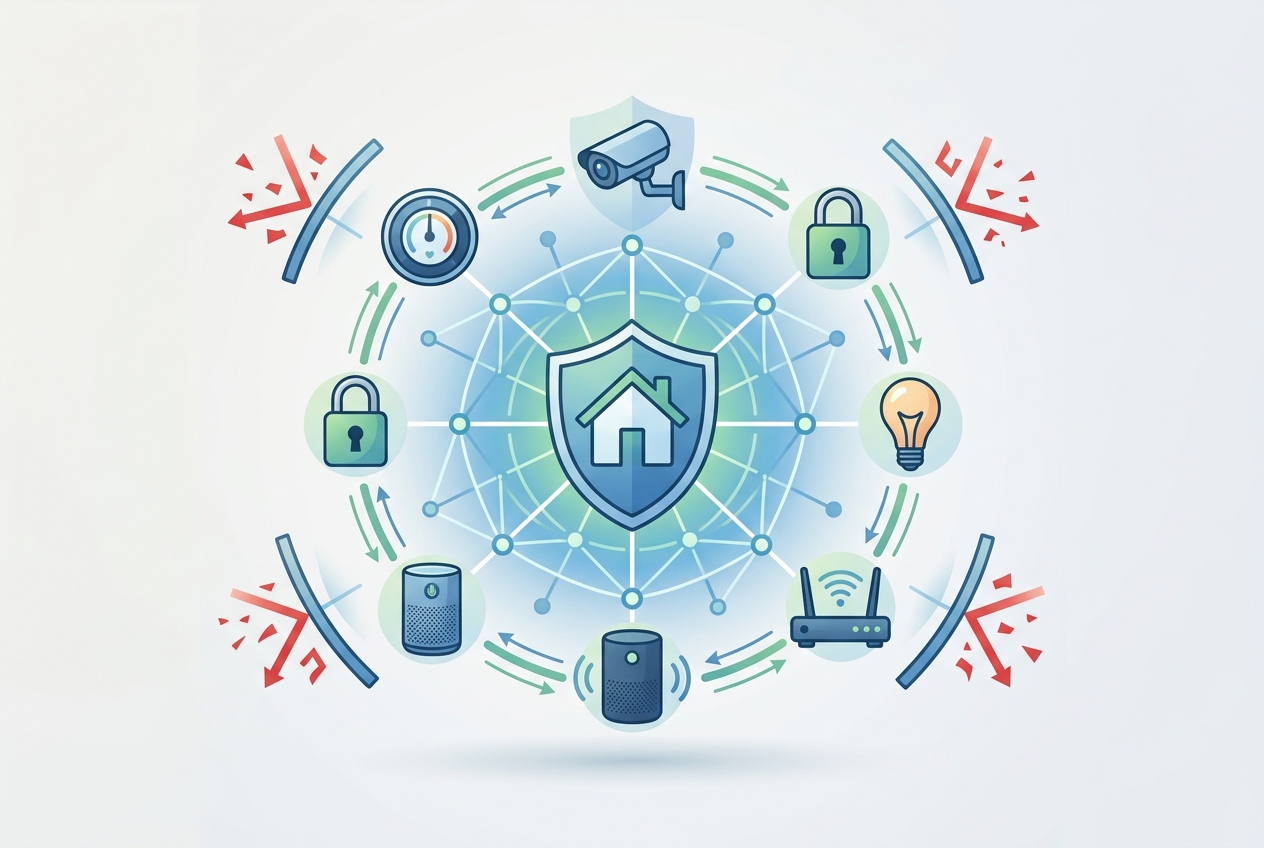

Learn essential privacy and security tips for smart home buyers, from data protection to device safeguards, ensuring a safe connected lifestyle.
Welcome to the world of connected living, where convenience meets risk. As you outfit your home with smart devices, understanding privacy and security becomes essential. This guide equips you with the knowledge to protect your data and your peace of mind.
Key Takeaways
- Encrypt all Wi‑Fi traffic.
- Change default passwords immediately.
- Segment IoT devices on a separate network.
- Regularly update firmware.
- Review privacy policies before purchase.
- Use multi‑factor authentication where possible.
- Monitor device behavior for anomalies.
What Is Smart Home Privacy and Security?
Smart home privacy and security refer to the practices and technologies that protect personal data and prevent unauthorized access to connected devices.
Expert Insight: Treat every device as a potential entry point; a single compromised sensor can expose an entire network.
Understanding the distinction is crucial: privacy focuses on data collection and usage, while security deals with safeguarding the hardware and software that process that data.
For a foundational overview, see the National Institute of Standards and Technology’s guide on IoT security NIST Cybersecurity Framework and the Federal Trade Commission’s consumer advice FTC Smart Home Tips.
Why Does Privacy Matter in Connected Homes?
Privacy matters because smart devices continuously collect intimate details—voice commands, daily routines, and even health metrics.
Expert Insight: Data harvested from a single thermostat can reveal when you’re home, making it valuable to burglars and marketers alike.
When privacy is compromised, the fallout can include identity theft, targeted advertising, and even physical safety risks.
Research from the University of California, Irvine highlights the correlation between data exposure and personal safety UCI Research on IoT Privacy. Additionally, the Cybersecurity and Infrastructure Security Agency (CISA) outlines best practices for protecting personal data CISA IoT Guidance.
Common Threats and Vulnerabilities
Smart homes face a range of threats, from simple password guessing to sophisticated botnet attacks.
Expert Insight: The most common mistake is leaving factory defaults unchanged, which attackers exploit instantly.
| Threat | Typical Target | Impact |
|---|---|---|
| Unauthorized Access | Smart locks, cameras | Physical intrusion, privacy breach |
| Data Interception | Voice assistants | Personal info leakage |
| Botnet Recruitment | IoT hubs | Large‑scale DDoS attacks |
Beyond these, firmware vulnerabilities and insecure APIs can be exploited remotely. The Department of Homeland Security warns that unpatched devices are a leading vector for ransomware DHS Ransomware Alert. The Electronic Frontier Foundation also discusses the privacy implications of voice assistants EFF Voice Assistant Review.
Tools / Practical Applications
Effective tools empower users to monitor and harden their smart home ecosystems.
Expert Insight: A network scanner combined with a strong password manager creates a layered defense that is hard to bypass.
Key tools include:
- Network segmentation routers (e.g., guest Wi‑Fi).
- Device‑level firewalls.
- Automated firmware update services.
- Privacy‑focused DNS resolvers.
For practical implementation, refer to the Center for Internet Security’s checklist CIS IoT Benchmark and the National Cyber Security Centre’s guide on secure home networking NCSC Secure Home.
What Should You Do Next?
Taking immediate, actionable steps can dramatically reduce risk.
Expert Insight: Prioritize changing default credentials before any other configuration.
Recommended next steps:
- Change all default usernames and passwords.
- Enable WPA3 encryption on your Wi‑Fi.
- Set up a dedicated VLAN for IoT devices.
- Schedule regular firmware updates.
- Review each device’s privacy settings and opt‑out of unnecessary data sharing.
Resources to guide you include the Federal Communications Commission’s security tips FCC Consumer Tips and the Center for Democracy & Technology’s privacy framework CDT Smart Home Privacy.
Conclusion
Smart home technology offers unparalleled convenience, but it also introduces new privacy and security challenges.
Expert Insight: Treat privacy and security as ongoing processes, not one‑time setups.
By understanding the landscape, employing robust tools, and following a disciplined maintenance routine, you can enjoy a connected home without sacrificing personal safety.
Further reading includes the National Institute of Standards and Technology’s IoT security roadmap NIST IoT Roadmap and the European Union Agency for Cybersecurity’s best‑practice guide ENISA IoT Best Practices.
AI Disclosure
This content was written by AI and reviewed by a human for quality and compliance.