

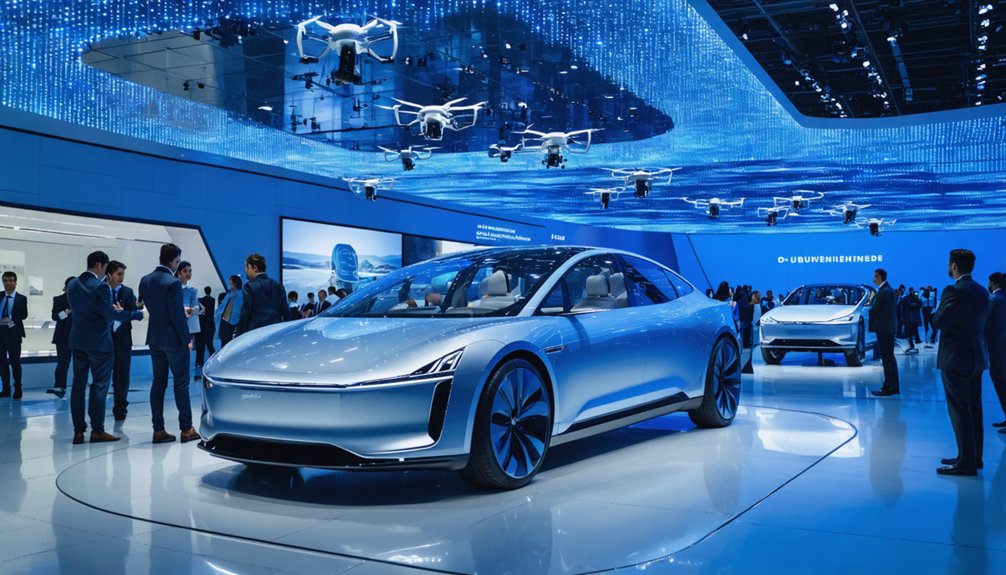

Recent auto tech conferences have showcased key trends that are shaping the automotive terrain. Electrification and sustainable practices are at the forefront, with significant growth in electric vehicle sales and hybrid powertrains. Advancements in autonomous driving technologies emphasize safety and real-time decision-making. Innovative user experiences, including intelligent cockpit designs and AI integration, enhance driver interactions. Finally, networking and experiential marketing strategies highlight the importance of collaboration and engagement in the developing automotive industry, clearing a path for future developments.
Highlights
- Electric vehicle technology is rapidly advancing with a projected 25% market share by 2025, emphasizing sustainability and reduced battery costs.
- Connectivity and autonomous driving are critical trends, with tech investments enhancing real-time decision-making and sensor integration for safer navigation.
- Innovations in user experience, including AI-driven interfaces and customizable cockpit designs, prioritize safety and personalization for drivers.
- AI tools in marketing enhance customer interaction, leveraging real-time data for hyper-personalized engagement and streamlined workflow management.
- Diversity and inclusivity are pivotal in driving innovation within the automotive community, showcased through initiatives from organizations like the African American Automotive Association.
Growing Focus on Electrification and Sustainable Practices
As the automotive industry increasingly shifts towards electrification, a significant focus on sustainable practices emerges, driven by both market forces and consumer demand. Electric trends indicate a phenomenal rise in EV sales, with projections showing they will constitute 25% of all vehicle sales by 2025. This demand is fueled by concerns over fuel costs and environmental impact. Green initiatives, including the development of efficient battery technologies, enhance driving range and affordability, further enticing consumers. The expanded charging infrastructure alleviates range anxiety, enabling a smoother shift for many drivers. Additionally, automakers emphasize sustainable sourcing of materials and transparent practices to connect with a growing segment of eco-conscious consumers, reflecting a collective desire for a greener automotive future. The dominance of EVs is supported by advancements in battery technology and government policies that promote sustainability in the automotive sector. Furthermore, the expected growth in global passenger EV sales highlights the increasing momentum towards widespread EV adoption, reinforcing the industry’s commitment to sustainability.
Advancements in Autonomous Driving Technologies
Rapid advancements in autonomous driving technologies are reshaping the terrain of mobility, underscoring a revolutionary shift in how vehicles interact with their environment. Major players like Waymo and Uber are pioneering Robotaxi expansion, extending autonomous taxi services to cities like Austin and Atlanta. Investment from tech giants such as Tesla and Amazon is driving the development of Autonomous Systems that aim to surpass human capabilities. Enhanced AI models facilitate real-time learning and decision-making, while superior sensor integration guarantees safer direction-finding. As supportive regulatory environments emerge, the reduced psychological barriers among users further encourage adoption. Additionally, intelligent speed assistance systems are becoming integral to these technologies, helping to improve road safety by ensuring drivers adhere to speed limits. Strategic partnerships within the industry are critical for scaling these pioneering services, signaling an innovative age of urban transportation. Furthermore, autonomous cars can now be seen navigating traffic in cities like San Francisco and Shanghai. The integration of connectivity into vehicles will further enhance autonomous driving capabilities by allowing real-time communication between vehicles and traffic infrastructure.
Intelligent Cockpits and User Experience Innovations
With the advent of advanced technology in the automotive sector, intelligent cockpits have emerged as a focal point for enhancing user experience and personalization in vehicles. Innovations in cockpit design now allow drivers to customize controls and settings, catering to individual preferences for diverse scenarios like commuting or entertainment. AI-driven user interfaces further augment these interactions, utilizing voice recognition and gesture control to create intuitive, adaptive environments. OEMs, such as Xiaomi and Li Auto, are leading the way with multi-device integration, linking cars to smartphones and smart home systems for seamless user experiences. This emphasis on flexibility and personalization not only prioritizes safety but also nurtures a sense of belonging within the growing automotive community, encouraging users to plunge into the world of connected driving. As Omdia-driven recommendations reveal, the integration of advanced driver assistance systems is also a vital aspect of enhancing the user experience in intelligent cockpits. Furthermore, the automotive intelligent cockpit market is projected to reach $77.09 billion by 2025, indicating a significant growth driven by rising demand for premium in-vehicle experiences. Additionally, a multitude of customizable settings enables drivers to create unique combinations for various driving scenarios.
Emerging Trends in Hybrid and Electric Vehicle Powertrains
The automotive industry is witnessing a significant metamorphosis driven by emerging trends in hybrid and electric vehicle powertrains. With the global hybrid powertrain market anticipated to surge from $130.98 billion in 2025 to $483.33 billion by 2034, manufacturers are responding to stringent emission regulations and increasing demand for fuel-efficient options. Technological advancements are optimizing hybrid systems, enhancing engine performance while minimizing emissions through intelligent load distribution between combustion engines and electric motors. This innovation, coupled with reduced battery costs and improved electric motor capabilities, is reshaping market forces. Mild Hybrid Electric Vehicles dominate, while Battery Electric Vehicles reflect notable growth, indicating a collective shift towards refined electric powertrains that enhance driving experiences, catering to urban needs and environmental goals. This evolving landscape is further fueled by growing demand for electric powertrains, which is expected to surge in the coming years, creating lucrative opportunities for industry players.
Dealer Engagement and Retail Innovations in the Automotive Sector
In a terrain increasingly dominated by digital revolution, dealer engagement and retail innovations are becoming essential for automotive businesses seeking to connect with tech-savvy consumers.
AI-driven tools have emerged as a landscape-shifting element for lead engagement, enhancing customer interaction through rapid inquiry responses and personalized nurturing.
Solutions like Ava AI and Conversica streamline workflows, enabling dealerships to manage leads efficiently, thereby countering common staffing challenges.
Social media strategies amplifying consumer engagement, including short-form videos and live Q&A sessions, forge authentic connections with potential buyers.
Additionally, hyper-personalization through first-party data guarantees targeted messaging, enhancing relevance and retention.
Networking Opportunities and Industry Collaboration
Networking opportunities and industry collaboration are essential components in the rapidly developing automotive sector, where technological advancements demand collective knowledge and resource-sharing.
Events like AutoTech 2025 and ASOTU CON serve as pivotal platforms that facilitate industry partnerships, allowing organizations to engage through dedicated Collaboration Tools.
The Collaboration Hub at these conferences encourages the exchange of innovative strategies, while key partnerships with 5G Americas advance connectivity crucial for next-gen vehicles.
Furthermore, initiatives from the African American Automotive Association highlight the importance of diversity in building a robust automotive community.
Experiential Marketing Strategies at Auto Tech Events
Auto tech events are increasingly incorporating innovative experiential marketing strategies to enhance attendee engagement and brand interaction.
By utilizing immersive storytelling through augmented reality (AR) and virtual reality (VR), brands provide attendees with interactive displays that allow them to delve into vehicle features in engaging ways.
Multi-sensory campaigns, including custom scent marketing and live demonstrations, evoke emotional connections, while haptic feedback systems simulate real driving experiences.
Real-time data analytics and AI-powered personalization further tailor interactions, enhancing satisfaction.
Additionally, cross-platform omnichannel experiences expand reach, as social media activations encourage attendees to share their moments live.
Conclusion
To summarize, the latest auto tech conferences have emphasized a revolutionary shift within the automotive industry, highlighting advancements in electrification, autonomous driving, and innovative user experiences. As participants investigate emerging powertrain technologies and dealer engagement strategies, the emphasis on sustainability and collaboration becomes increasingly evident. These trends not only reflect current market demands but also pave the way for a more connected and efficient automotive future, showcasing the industry’s commitment to innovation and responsible practices, ultimately leading to a more modernized automotive landscape, in final thoughts, the automotive industry is poised to revolutionize itself.