

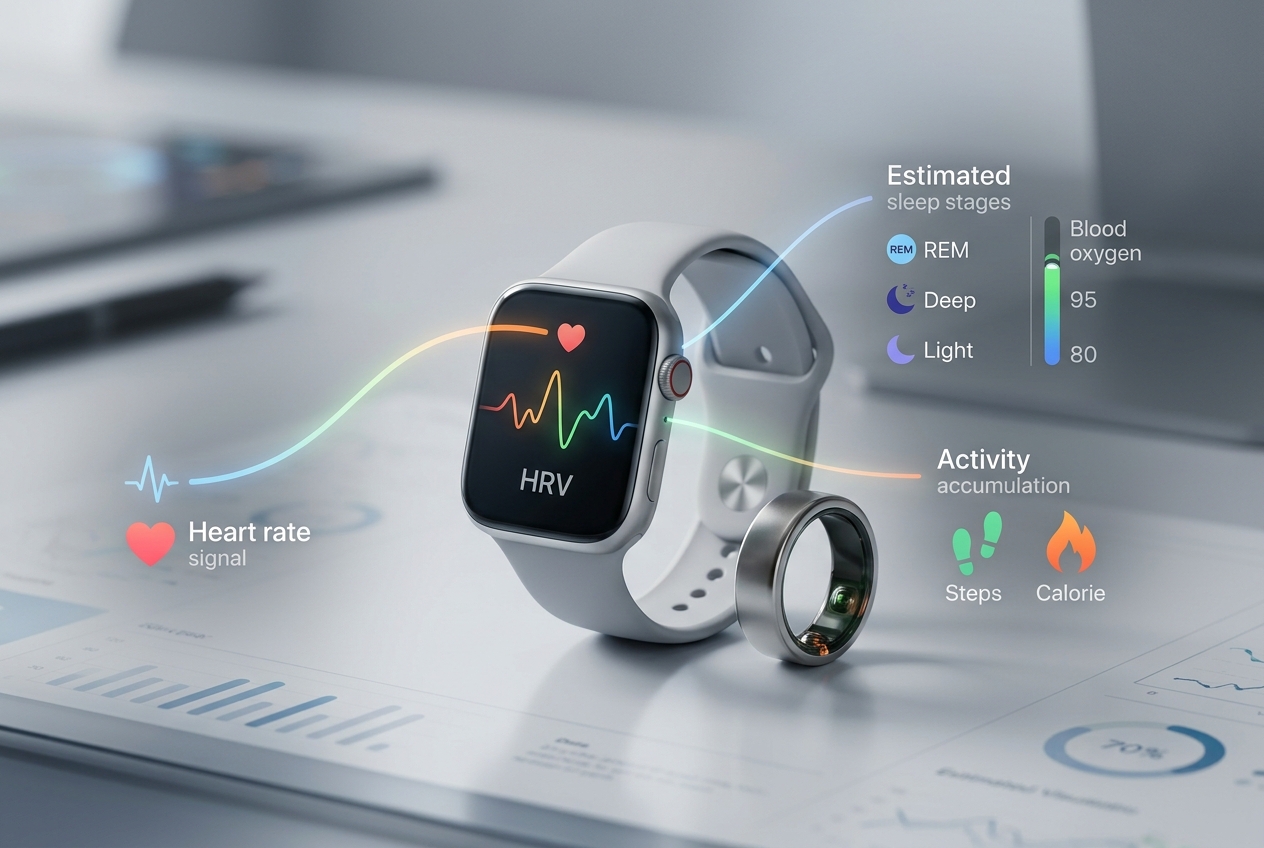

Explore how modern wearables decode heart rate, sleep, activity, and more, revealing actionable health insights while debunking common myths.
Wearables have moved beyond step counts, offering a window into physiological signals you never knew you could monitor. In this guide we’ll demystify the data they provide and show you how to interpret it wisely.
Key Takeaways
- Heart‑rate variability reveals stress and recovery.
- Sleep stages are estimated, not diagnosed.
- Blood‑oxygen sensors can flag hypoxia.
- Activity tracking helps calibrate calorie needs.
- Data quality varies by sensor technology.
- Regular calibration improves long‑term accuracy.
- Combine wearables with clinical testing for best results.
Understanding Wearable Sensors
Wearable devices use a handful of core sensors—photoplethysmography, accelerometers, gyroscopes, and sometimes ECG electrodes—to translate body movements and blood flow into digital metrics.
Expert Insight: Choose a device whose sensor suite matches the health goal you prioritize; a smartwatch with PPG may be sufficient for fitness, while a chest‑strap ECG is needed for arrhythmia detection.
Framework: Identify the sensor, map it to the metric, then validate against a clinical gold standard.
Trade‑off: More sensors increase data richness but also battery drain and cost.
Common mistake: Assuming a single sensor can capture complex phenomena like stress without contextual data.
For deeper technical background, see the CDC’s guide on wearable validation CDC Physical Activity Data and the MIT research on sensor fusion MIT Sensor Fusion Study.
| Sensor | Primary Metric | Typical Accuracy |
|---|---|---|
| PPG (optical) | Heart rate, SpO₂ | ±3 bpm at rest |
| Accelerometer | Steps, activity intensity | ±5 % error |
| Gyroscope | Posture, rotation | ±2 ° |
| ECG electrodes | Heart rhythm | Clinical‑grade when 5‑lead |
Why Accuracy Matters
Accurate measurements are the foundation for trustworthy health insights; a 5 % error in resting heart rate can mislead fitness plans and medical decisions.
Expert Insight: Cross‑check wearable data with a manual pulse count or a medical device at least once a month to spot drift.
Framework: Use the “Three‑Check” method—device, manual, and clinical—to confirm critical readings.
Misconception: “If the app says I slept 8 hours, I’m fully rested.” In reality, sleep quality depends on stages, not just duration.
Why it matters: Over‑reliance on inaccurate data can cause unnecessary anxiety or missed warning signs.
Further reading: The National Heart, Lung, and Blood Institute explains measurement error NHLBI Heart Health and the WHO’s guidance on personal health monitoring WHO Personal Monitoring.
Common Misconceptions
Many users treat wearable outputs as definitive diagnoses, but most devices are designed for trend monitoring, not clinical grading.
Expert Insight: Treat the data as a “coach” that highlights patterns, not a doctor that delivers prescriptions.
Framework: Separate “trend metrics” (e.g., weekly step average) from “snapshot metrics” (e.g., single heart‑rate spike).
Trade‑off: Higher granularity provides more detail but can overwhelm users with noise.
Common mistake: Ignoring the need for proper skin contact, leading to poor signal quality.
Authority sources: The U.S. Department of Health & Human Services outlines device limitations Healthcare.gov Fitness Tracking and the American Heart Association discusses wearable reliability AHA Heart Health.
Tools / Practical Applications
Wearables can be integrated into daily routines for sleep optimization, stress management, and chronic disease monitoring.
Expert Insight: Pair your device with a reputable app that offers evidence‑based recommendations, such as the NIH’s Sleep Coach.
Framework: Set a measurable goal, use the device to track, review weekly trends, adjust behavior.
Why it matters: Consistent feedback loops improve adherence to health plans.
Real‑world example: A diabetic patient uses continuous glucose monitoring alongside a smartwatch to correlate activity spikes with glucose dips.
Helpful resources: The National Sleep Foundation’s sleep‑tracking guide Sleep Foundation Tracker Guide and the CDC’s stress‑reduction toolkit CDC Stress Techniques.
What Should You Do Next?
Start by auditing the sensors you already own, then align them with a health objective—be it improving sleep, managing weight, or monitoring cardiac rhythm.
Expert Insight: Keep a simple journal noting how you feel when the device flags an anomaly; this context is priceless for clinicians.
Checklist: 1) Verify sensor placement, 2) Calibrate with a known reference, 3) Set realistic alerts, 4) Review data weekly, 5) Share key trends with a healthcare provider.
Trade‑off: More frequent alerts can motivate but may also cause alert fatigue.
Why it matters: Structured follow‑up turns raw numbers into actionable health decisions.
Further guidance: The Harvard T.H. Chan School of Public Health provides a step‑by‑step wearable integration plan Harvard Wearable Integration and the NIH’s personalized medicine portal NIH Precision Medicine.
Conclusion
Wearable health devices offer a window into your physiology, but the view is only as clear as the sensor quality, user habits, and proper interpretation.
Expert Insight: Use wearables as a supplement, not a substitute, for professional medical evaluation.
Remember: Accurate data, consistent usage, and critical thinking together unlock the true potential of these gadgets.
For standards on measurement reliability see NIST Measurement Science and ACSM’s wearable guidance ACSM Wearable Guidance.
AI Disclosure
This content was written by AI and reviewed by a human for quality and compliance.