

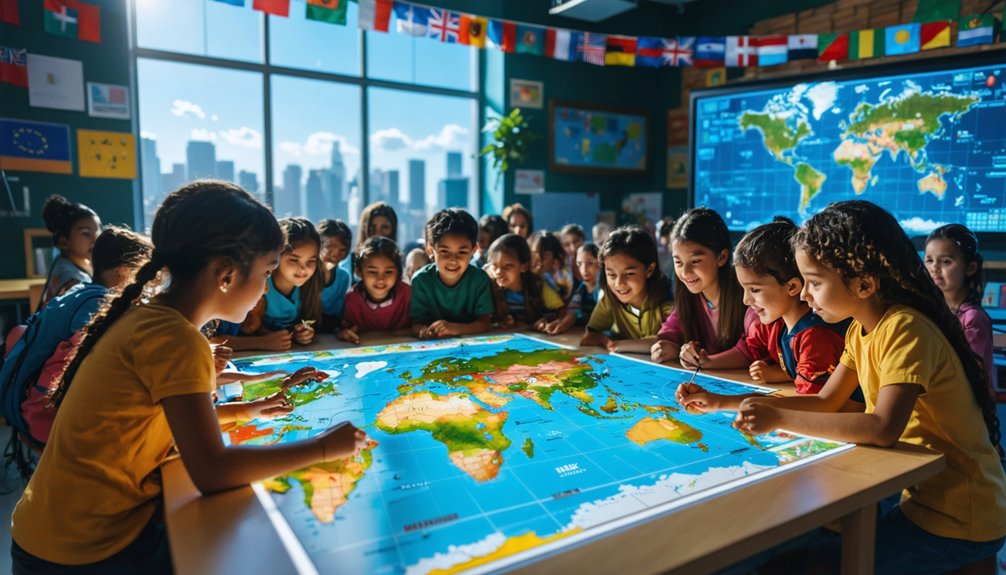

Global learning exchanges are on the rise due to enhanced access to education through global partnerships and increasing student interest in international experiences. Economic benefits play a vital role, as these exchanges contribute substantially to local economies and job creation. Additionally, geopolitical shifts and technological advancements facilitate an environment conducive to cross-cultural competence. This evolution in education reflects a complex interplay of factors that continue to shape global learning. More perspectives await on this evolving trend.
Highlights
- Geopolitical shifts and economic uncertainties boost the appeal of affordable, quality education abroad for many students.
- Increasing enrollment in study abroad programs indicates growing interest in diverse cultural experiences and global education.
- Collaborative efforts among organizations foster inclusive education policies, enhancing access and encouraging international exchanges.
- The rising global education market, valued at approximately $7.6 trillion, drives investment in online learning and international collaborations.
- The benefits of cross-cultural competence and diversity promote enhanced communication skills and innovation, attracting students to global learning environments.
Increasing Access to Education Through Global Partnerships
Access to education remains a critical challenge globally, yet innovative global partnerships have emerged as a vital solution. Initiatives like the Global Partnership for Education (GPE) have allocated $1.1 billion to strengthen education systems, particularly benefiting marginalized children, including girls and those with disabilities. By 2025, these partnerships aim to construct or renovate nearly 92,000 classrooms, increasing school capacity and supporting education equity. Additionally, policies centered on gender-responsive education planning have been catalyzed by collaborative efforts with organizations like UNESCO and UNICEF. This commitment drives nations to invest 4 to 6% of GDP in education, targeting a reduction of 165 million out-of-school children by 2030, thereby making strides towards equitable access for all learners across various environments. Furthermore, the World Bank Group is the largest external financier of education in developing countries, illustrating the significant impact that access to education can have not only on individuals but on overall economic development as well. Education accounts for 50% of global economic growth, thus illustrating the significant impact that access to education can have not only on individuals but on overall economic development as well.
Growth in Study Abroad Programs and Academic Fields
As universities worldwide adapt to the changing scenery of education, the surge in study abroad programs reflects a growing recognition of their importance in nurturing cross-cultural understanding and academic diversity.
Recent global trends show a staggering increase of 1,300% in U.S. student enrollment from 2020/21 to 2021/22, with popular destinations like Ireland witnessing enrollment surges of up to 3,200%. This growth is particularly noteworthy in regions like the United Kingdom, which continue to maintain their status as preferred study-abroad destinations due to prestigious institutions. Additionally, international students accounted for 6% of the total US higher education population, highlighting the expansive nature of global learning exchanges. Furthermore, the economic impact of international students’ contributions has been increasingly recognized as beneficial to host countries, underlining the significance of these educational exchanges.
The emphasis on fields such as STEM has led to a notable rise in students pursuing math and engineering programs abroad. Cultural immersion opportunities enhance academic experiences, contributing to students’ personal growth and skill development.
As international student mobility expands, universities increasingly recognize the value of diverse academic environments in shaping future leaders capable of traversing a globalized world.
Economic Impact and Community Benefits of Exchange Programs
The economic impact and community benefits of exchange programs are substantial, markedly influencing both local and national economies. International students contribute billions annually, with over 1.1 million generating approximately $43.8 billion in the U.S. alone, supporting hundreds of thousands of jobs across diverse sectors. Furthermore, the economic contributions of international students were at the highest amount ever calculated, underscoring their vital role in strengthening the economy. In fact, for every three international students, one U.S. job is created or supported, highlighting their role in job creation. Additionally, Terra Dotta’s commitment to affordable programs fosters opportunities for a greater number of students to participate in exchanges, further enhancing the economic and cultural impact.
This influx not only promotes economic benefits but also enhances cultural exchange, enhancing local communities through interaction and cooperation. States like California and New York reap significant economic activity from these programs, emphasizing their importance. Additionally, the long-term retention of international students can lead to deep workforce integration, addressing labor shortages and driving local innovation.
Ultimately, exchange programs cultivate a sense of belonging, bridging cultural differences and promoting mutual understanding within communities, which can further prompt individuals to plunge into new experiences, and in turn, fortify community ties, contributing to a more nuanced cultural landscape.
Expanding Global Education Market and Technology Integration
Growth within the global education market demonstrates a significant metamorphosis shaped by advancing technology and changing demands. Valued at approximately $7.6 trillion, this sector is developing rapidly, with rising investments in online learning and digital transformation. K-12 and higher education markets are projected to reach $732.94 billion and $2.56 trillion respectively by 2034, illustrating the increased focus on accessible, quality education. The integration of smart devices, interactive platforms, and generative AI tools is revolutionizing teaching methods, enhancing personalized learning experiences. Government initiatives further support this path, as they recognize the importance of upskilling for a future-ready workforce. Additionally, the global education and training market is expected to grow at a CAGR of 17.4% from 2025 to 2033, emphasizing the need for innovative educational practices in an increasingly interconnected world. Together, these elements emphasize the growing significance of innovative educational practices that promote unity in an increasingly interconnected world.
Geopolitical and Social Factors Influencing Global Learning Exchanges
While the landscape of global learning exchanges is profoundly shaped by geopolitical dynamics, social factors also play a vital role in determining participation and engagement levels.
Geopolitical shifts, such as rising international student mobility in Europe and Asia, reflect the changing tides of global migration and the quest for educational equity.
Simultaneously, socioeconomic shifts driven by economic uncertainties enhance the appeal of cost-effective education, impacting student choices.
Diverse student populations highlight the need for inclusive support systems to nurture belonging.
Additionally, increasing social awareness of issues like sustainability shapes curricula, embedding social impact learning into exchange programs.
Together, these factors create a rich mosaic that influences global learning exchanges, emphasizing the interconnectedness of geopolitical and social landscapes, where it is essential to take a plunge into the complexities, as they are vital in determining participation, and are intertwined into a complex brocade, reflecting a changing, significant impact on the scenery.
Benefits of Cross-Cultural Competence
Participation in global learning exchanges not only enhances students’ educational paths but also cultivates crucial cross-cultural competence that extends beyond academic domains. This competence includes enhanced cultural awareness and communication skills, leading to reduced misunderstandings and increased empathy.
Through diversity training, individuals gain perspectives into varied consumer behaviors, facilitating customized marketing strategies and improving customer relations. Furthermore, exposure to diverse viewpoints promotes creativity and innovation, as multicultural teams generate novel solutions.
Ultimately, organizations that prioritize cultural competence report better employee engagement and lower turnover, creating a psychologically safe environment where diverse voices are valued. Consequently, the benefits of cross-cultural competence reverberate throughout educational and professional terrains, promoting inclusivity and collaboration.
Enhancing International Collaboration Through Education
Enhancing international collaboration through education has emerged as a vital strategy for addressing global challenges and nurturing innovation. With over 1.1 million international students in the U.S. and significant contributions to various economies, educational institutions are increasingly prioritizing cultural diversity.
This diversity compels faculty to innovate curricula, incorporating international case studies and responding to global labor market demands. Such collaboration helps bridge language barriers, enhancing the learning experience and promoting intercultural understanding. Additionally, the expansion of international K-12 schools promotes global networking from an early age.
As these initiatives flourish, they enable students worldwide to connect, collaborate, and thrive in an interconnected environment, ultimately strengthening the global community through shared educational experiences, which is a vital aspect that allows them to take a leap into global engagement.
Conclusion
In conclusion, the rise of global learning exchanges reflects a significant shift towards greater accessibility and collaboration in education. As partnerships flourish and study abroad opportunities expand, the economic and social impacts become increasingly evident. Technology enhances this landscape, facilitating cross-cultural competence and fostering international cooperation. Amidst shifting geopolitical dynamics, these exchanges not only enrich individual experiences but also contribute to a more interconnected and understanding global community, underscoring the value of shared knowledge and diverse perspectives.